
SIMPLY RECLAIMED
Compassionate Decluttering Services & Hoarding Help in Nashville, TN
SAFETY FIRST. FUNCTION. PROGRESS ALWAYS.
When clutter has become difficult or overwhelming to manage, it can feel like there’s nowhere to start. Our decluttering services help you restore safety and function to your home, at your pace, without judgment, and with you in control of every decision.
Support For Extreme Clutter, Chronic Disorganization, & Hoarding
No one intends for their home to get out of control. But if it does, we’re here to support you and your family with compassion, respect, and a plan that actually lasts.
We are client centered, not stuff centered.
Level 2 Hoarding Specialist, Institute for Challenging Disorganization (ICD)
· Former lead supervising technician, bio-hazard franchise · Homes assessed with the ICD Clutter–Hoarding Scale · Judgment-free, always · You stay in control

You’ve tried to handle it on your own. It keeps getting harder
Maybe you can’t cook in your kitchen anymore, or you’re sleeping somewhere other than your bed. Maybe you’ve started turning down visits from family and friends because you don’t want them to see the house. Maybe you’ve tried to tackle it again and again, and the clutter always seems to win.
Living like this can bring a heavy weight of embarrassment, shame, guilt, and isolation. And sometimes the pressure comes from outside, too: a family member’s ultimatum, a landlord’s deadline, or a move that can’t happen until the home is cleared.
You don’t deserve to feel this way in your own home. Everyone deserves a safe and functional space from which they can thrive, no matter what caused the clutter.
Emptying a House In a Day Doesn’t Solve The Problem
Many hoarding cleanup services use a rapid clean-out: a crew, a dumpster in the driveway, and a house emptied fast. In our experience, that approach can leave people feeling violated and out of control, grieving what was lost, and even more attached to what’s left. It changes the house, but not the habits and decision-making skills that keep clutter from coming back. That’s why the clutter often returns.
We take a different path, one that makes your home safe while keeping you in the driver’s seat.
Why Our Decluttering Services Are Different
A Hazard Reduction Approach
We ask one question first: what is the safest, most appropriate way to reduce hazards while keeping you involved in the process? We work incrementally instead of expecting your home to be transformed all at once. You may not be ready for everything to go, and that’s okay. The goal is to make sure you’re safe, even while many of your belongings are still there.
You Stay in Control
The final decision about what to keep, donate, or discard is always yours. When decisions feel hard, we help you:
- Break big decisions into smaller, more manageable ones
- Answer neutral questions that help you figure out what matters to you
- Sort items into keep, donate, discard, or undecided
- Identify priorities when everything feels important
- Recognize patterns
- And we respect it when your answer is no
We Leave Your Home Organized, Not Just Emptied
We leave your home organized, not just emptied
Most cleanup services remove items, maybe clean, and then leave. We don’t leave things strewn about. Once your home is safe, we organize it so you know where everything is and your home truly works for you.
How Our Decluttering Process Works

Consultation & Plan
It starts with a free 30-minute phone call where we listen, without judgment. Then, at an in-home consultation, we identify hazards, assess your home using the ICD Clutter–Hoarding Scale, and create a plan built around your abilities, goals, and needs.

Safety First: Hazard Reduction
Your first sessions focus on making your home safe: clearing pathways and stairs, opening up exits, removing trip and fire hazards, restoring access to utilities, securing tall stacks, and safely disposing of spoiled food, so you can move through your home with confidence.

Function: Restoring Daily Life
Once your home is safe, we restore its essential functions, so you can cook on clear counters, sleep in your bed, use your bathroom and shower, reach your clothes and personal items, and do your laundry again.

Progress Always: Built to Last
We give everything you keep a home where it’s easy to find and put away, then set up simple systems, like a drop zone or a spot for mail, to keep clutter at bay. Optional Simply Maintained visits help you stay on track.
Responsible, Discreet Removal
Items in good condition are donated, and we handle the donation drop-offs for you. For things that can’t be donated, we arrange the most cost-effective option, whether that’s a dumpster rental or a junk removal service after your sessions. As we sort, we set aside important papers, photos, keepsakes, and valuables for you. And because we work step by step, our process is often far more discreet than a crew with a dumpster in your driveway.
When A Faster Clean-Out Is The Right Call
Sometimes things truly need to move quickly. In these specific situations, we also offer rapid clean-outs:
- A loved one has passed, and the family needs the home cleared
- Health or mobility concerns make staying in a cluttered home risky
- A city or landlord requires the home to be safe by a certain date
- An infestation is affecting neighbors
Helping a Loved One With Extreme Clutter
Many calls come from adult children, siblings, and friends who are worried about someone they love. Family members are always welcome to reach out, and we’ll talk with you first. Ultimately, your loved one needs to be on board with the process. Lasting change happens when they’re part of the decisions, not when things are done to them.
A few signs a loved one may be struggling:
- They avoid having visitors, or steer you away from certain rooms
- They rent storage units without a clear reason
- They become distressed at the thought of letting things go
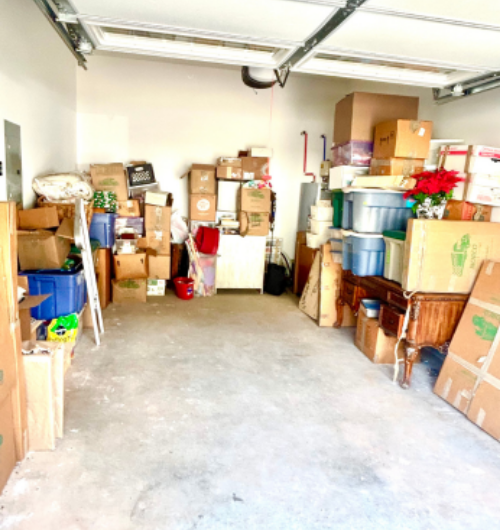
- Their garage or spare rooms are packed wall to wall
It’s also important to know that having a lot of belongings doesn’t automatically mean someone has hoarding disorder. Hoarding exists on a spectrum, and only a qualified mental health professional can diagnose it. We’re not here to label anyone. We’re here to help with the clutter itself.
Understanding The 5 Levels of Clutter
When most people hear “hoarding,” they picture the extreme homes shown on TV. But clutter exists on a spectrum, measured by how well a home supports daily living, not just by the amount of stuff. We use the Institute for Challenging Disorganization’s Clutter–Hoarding Scale to assess each home.
LEVEL 1
Everyday Clutter
A bit of clutter, but the home is safe and fully functional.
LEVEL 2
Noticeable Disorganization
Clutter in multiple rooms, and daily routines start to feel inconvenient.
LEVEL 3
Chronic Clutter BuildUp
Some rooms can no longer be used as intended, and pathways narrow.
LEVEL 4
Hazardous Clutter
Safety and health risks, like blocked exits, spoiled food, or hard-to-reach utilities.
LEVEL 5
Severe Hoarding
Large parts of the home are unusable, with serious hazards.

Trained For The Most Challenging Homes
Nina Alferio is a Level 2 Hoarding Specialist through the Institute for Challenging Disorganization (ICD).
Her passion for this work began with volunteering, taking a hazard reduction approach to create safer pathways and better emergency access for people with mobility challenges and medical concerns.
As a former lead supervising technician with a bio-hazard franchise, she has worked in all levels of clutter, including very challenging
What Our Client Say
“Nina will help shovel out bedrooms, closets, and garages. She did four sessions in the master bedroom and closet, helping make the space safe and navigable. Two days in the garage with boxes stacked and strewn everywhere resulted in a largely cleared floor, access to the stairs and water heater, and a significant reduction in unused items, moldy linens, and loads of unimportant papers. Well worth her weight in gold.”
– Rebecca P.
“You’re the only person that has been truly able to help me in my particular situation, I appreciate it.”
– Donna G.
“Worked with Nina in my overcrowded garage. 100% recommend her! She’s thoughtful, sensitive, and efficient.”
– Stefanie K.
What Success Looks Like
Success isn’t perfection, and it isn’t getting rid of everything you own. It’s being able to move safely through your home, cook a meal, sleep in your bed, and invite the people you love over, sometimes for the first time in a long time. It’s the weight of shame finally lifting. It’s understanding yourself a little better and having the tools to keep your home the way you want it.
And even if there’s a setback down the road, you’ve still made real progress. We’ll be here if you need us.
What We Do, & What We Don’t
We’re professional organizers, not cleaners. To keep you and our team safe:
- We don’t handle biohazards like mold, human waste, hazardous chemicals, or asbestos. For those, we coordinate with trusted remediation professionals, then return to finish organizing once it’s safe.
- We can’t enter homes with severe structural damage. A general contractor needs to address that first.
- We can work around minor signs of rodents or insects, but serious infestations need pest control before we begin.
- We don’t do work that requires specialized licenses, but we’re happy to coordinate with the professionals who do.
Decluttering Services & Hoarding Help Across Nashville
We provide decluttering services and hoarding help throughout Nashville and nearby communities, including:
East Nashville
Green Hills
Brentwood
Franklin
Mount Juliet
Hendersonville
Nolensville
Kingston Springs
Gallatin
Surrounding Areas
Frequently Asked Questions
Are you a hoarding cleanup service?
We’re professional organizers who specialize in extreme clutter, chronic disorganization, and hoarding situations. Instead of a rushed clean-out, we use a hazard reduction approach: we make your home safe, restore its function, and then organize it, with you making the decisions along the way.
How much do decluttering services cost?
Every home is different, so we don’t list set prices. For extreme clutter and hoarding situations, we provide an estimate after visiting your home in person.
Will you throw my things away?
Never without your permission. You decide what stays and what goes. When you’re ready to let things go, we donate what we can and arrange responsible removal for the rest.
Do I need to be home during sessions?
Yes. Because you’re the one making decisions, you’ll need to be on-site. If you can’t be present, we need written and verbal authorization for us to enter your home and to make decisions, or for a family member to make them on your behalf.
How long does it take?
It depends on your home and the pace that feels right for you. Most sessions last 4–6 hours, and we work incrementally over several sessions so it never feels overwhelming.
Do I need to clean up before you come?
No. Please don’t worry about preparing. We meet your home exactly as it is, without judgment.
Can I contact you on behalf of a family member?
Yes. We’ll talk with you first. Since lasting change works best when your loved one is on board, we’ll help you think through how to involve them.
Does having a lot of clutter mean someone has hoarding disorder?
Not necessarily. Someone can have a hoard without having hoarding disorder, which can only be diagnosed by a mental health professional. Many people simply have extreme clutter or chronic disorganization. Either way, we’re here to help with the clutter itself.
Do you work with therapists?
Yes. We focus on your home and the everyday skills that keep it manageable, and we highly recommend working with a therapist to address the deeper roots of hoarding.
Is my situation too much for you?
Every home is evaluated during your consultation. If we can’t safely help right away, we’ll refer you to the right specialist, like biohazard cleanup, pest control, or a contractor, and come back to finish organizing once it’s safe.
Is this private?
Yes. Every project is handled with discretion, and photos of your home are only shared with your permission.
Reclaim Your Space, One Step At A Time
You don’t have to face this alone. When you’re ready, let’s talk about what would help most.